
Introducing ‘Fiberhoods’: untapped opportunities for broadband investments
Charting options to expand connectivity in Appalachia and beyond
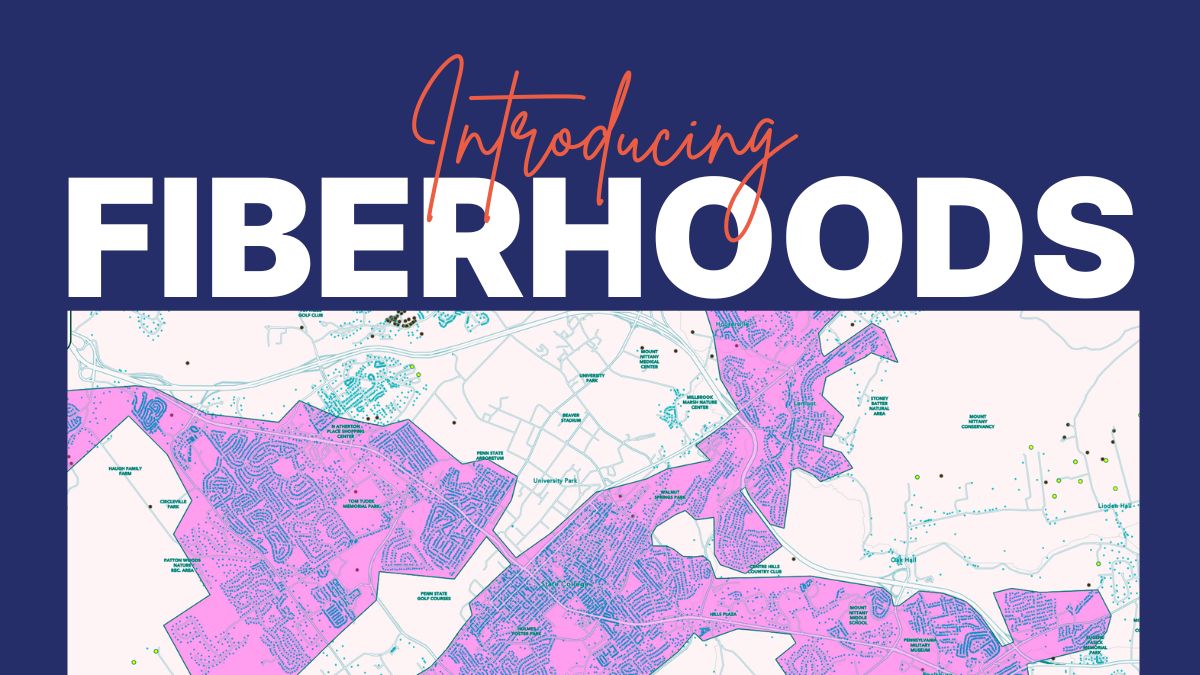
Reid Consulting has created the concept of “fiberhoods” to identify neighborhoods with strong potential for privately funded fiber deployments. This tool will support participants of Connect Humanity’s Appalachia Digital Accelerator to attract ISP partners, expand broadband access, and strengthen connectivity across the region.
Right now, fiber-to-the-home providers have a unique opportunity to become market leaders in small cities, large towns, and high population density rural areas where cable modem currently is the only option. We call these areas “fiberhoods” because they are neighborhoods large enough to support a privately funded fiber deployment but small enough that the incumbent cable provider is not motivated to upgrade on their own. The first company to deploy fiber to such a market typically captures the majority of customers in short order.
Finding the Perfect Fiberhood
The ideal fiberhood has:
- No existing fiber: The first fiber provider to overbuild an incumbent cable company can expect at least a 40% take rate. If the cable company has not kept up with maintenance or upgrades – something that often happens in rural areas – then the take rate can go as high as 60% or even 80%. Because the satisfaction rate for fiber service is so high, the fiberhood approach only works for the first fiber provider to enter a market. In communities with two fiber providers, the company who entered the market first has a distinct advantage. The second comer often has trouble achieving even a 25% take rate.
- High population density: It costs the same to build a mile of fiber regardless of whether that mile passes a single home or a hundred. The higher the density, the better the return on investment. You can see this financial calculus in action in large cities. Most companies like to see at least 60 locations per mile. As a result, densely populated neighborhoods, even ones with relatively low income, will have fiber while adjoining high-income, low-density neighborhoods have only cable.
- A large footprint: A national player won’t consider competing with an established cable company unless there are thousands or even tens of thousands of households in a potential service area. The more the better. On the other hand, local and regional players can be more willing to consider areas as small as a few hundred locations, especially if there is existing infrastructure nearby that would allow them to string together a series of small population clusters.
Fiberhoods and the Digital Divide
Although most fiberhoods are not eligible for grant funding, they still can help bring broadband to adjoining unserved and underserved locations. How? By sweetening the financial outlook for potential grant applications. In some cases, population density is so low that it can be difficult to create a sustainable business model to reach all unserved and underserved locations, even with a large grant subsidy.
Having one or more fiberhoods nearby can make a huge difference. Even fiberhoods that are too small to support a stand-alone deployment can shift a grant proposal’s financial model from money losing to money making. ISPs are much more willing to submit a grant proposal for a low-density area if they can pick up subscribers in an adjacent high-density area using the same infrastructure.
Fiberhoods Big and Small
Population density varies widely across Appalachia, and so do fiberhood opportunities. For example, central Pennsylvania and northeastern Ohio both include small cities and large towns that are textbook examples of fiberhood opportunities: thousands of homes with only a single cable provider.


On the other end of the spectrum, the 18 West Virginia and 5 Kentucky counties that are working with Connect Humanity have such low population density that fiberhood opportunities are few and far between. Most of the fiberhoods in West Virginia and Kentucky are small enough that they are best treated as potential add-ons to grant awards rather than as stand-alone opportunities.


Over the next few years, we anticipate that the window will close on fiberhood opportunities. Fiber-to-the-home now is the de-facto standard for high quality broadband service, and forward-thinking ISPs already are looking for communities where they can successfully compete with poorly performing cable companies. With the BEAD grant program moving forward, now is the time to encourage ISPs to combine grant projects with fiberhood opportunities.
Regardless of whether your community has many fiberhoods or just a few, we suggest sharing those areas with local and regional internet service providers. If any of your fiberhoods include or are next to BEAD-eligible locations, make sure to highlight this.
__
Reid Consulting has identified Fiberhood Opportunities in Appalachia Digital Accelerator geographies across 11 states: Georgia, Kentucky, Maryland, New York, North Carolina, Ohio, Pennsylvania, South Carolina, Tennessee, Virginia, and West Virginia.
If you’re interested in learning more about the analysis, please contact accelerator@connecthumanity.fund.
Keep in touch
To learn more about our work follow us on social media, subscribe to our newsletter, and write to us anytime at info@connecthumanity.fund.