
Connect Humanity
2023 Highlights


Welcome.
At the height of Covid-19, a group of us got together to think about how we can best help create a fairer, more resilient society in the aftermath of the pandemic. Our answer was Connect Humanity: a fund to make sure that internet access, which had proved to be a lifeline, is out of reach of no one. Even with historic funding in the form of the $42.5 Billion BEAD program, millions in the US and billions more around the world are at risk of remaining unconnected and falling further behind just by staying where they are. A moment of such great need and opportunity calls for urgency.
Read on to see what urgency looked like in 2023. We innovated financial models that offer community-focused internet service providers the type of capital they need to connect the unconnected. Our partnerships in Macon, Alabama and with Hawk Networks are excellent examples. We launched programs, like the multimillion-dollar Appalachia Digital Accelerator, which will support more than 50 of the country's least connected communities with planning, partners, and funding required to build fast, affordable next-generation networks. The work we’ve done with our partners is already bearing fruit. For example, earlier this year, we cheered alongside residents in East Carroll Parish, Louisiana at the groundbreaking of the construction of a new fiber network. After supporting the local broadband taskforce for two years, it's inspiring to see their hard work pay off.
As unprecedented as the government's broadband investments are, they alone will not close the digital divide. As our friends at the National Digital Inclusion Alliance (NDIA) have said, this must be a movement, not just a moment. This year, we’ve worked to determine the best role we can play to accelerate digital equity for all, outlined in our updated strategy. This strategy focuses on bringing more funders and investors into this movement to ensure that everyone — wherever they live and whatever their background or income — has access to the digital tools needed to thrive.
We always welcome feedback, ideas, and partnership discussions. Email us at info@connecthumanity.fund. Thank you for your dedication and support.
Jochai Ben-Avie
Co-founder and CEO
A snapshot of
Connect Humanity's 2023
The largest-ever mapping of civil society's digital barriers
Representing the experiences of over 7,500 practitioners across 136 countries, the State of Digital Inequity report gives an unparalleled insight into the digital challenges facing civil society and the communities they serve.
While 95 percent of organizations said the internet is vital to their ability to do their work, three in four said that a lack of internet access, tools, or skills limits their ability to effectively serve their communities.
The message is clear: Not only is the internet today a basic right, it is critical to the success of all civil society organizations, whether they work on education or the environment, hunger or healthcare. That’s why we have consistently made the case that we can’t meet the SDGs without closing the digital divide.

Building starts in East Carroll, Louisiana
“Finally, we can see a brighter future ahead of us in East Carroll Parish”
We continue to support the work of church-based group Delta Interfaith in East Carroll, including by helping fund its digital navigator program and working on an investment deal that would bring the network into community ownership.
A deal in Alabama demonstrated the impact of blended capital
Connect Humanity was founded with the belief that blending different sources of capital — public, commercial, and philanthropic — will be essential to catalyzing viable broadband projects in some underserved communities.
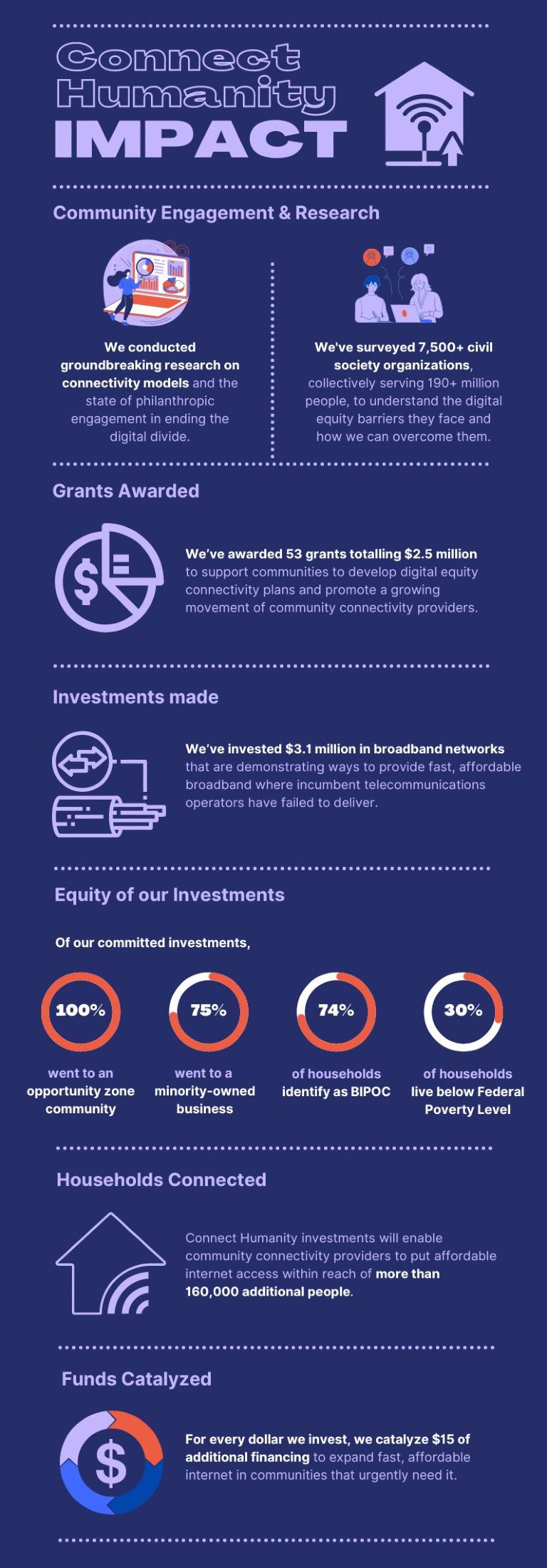
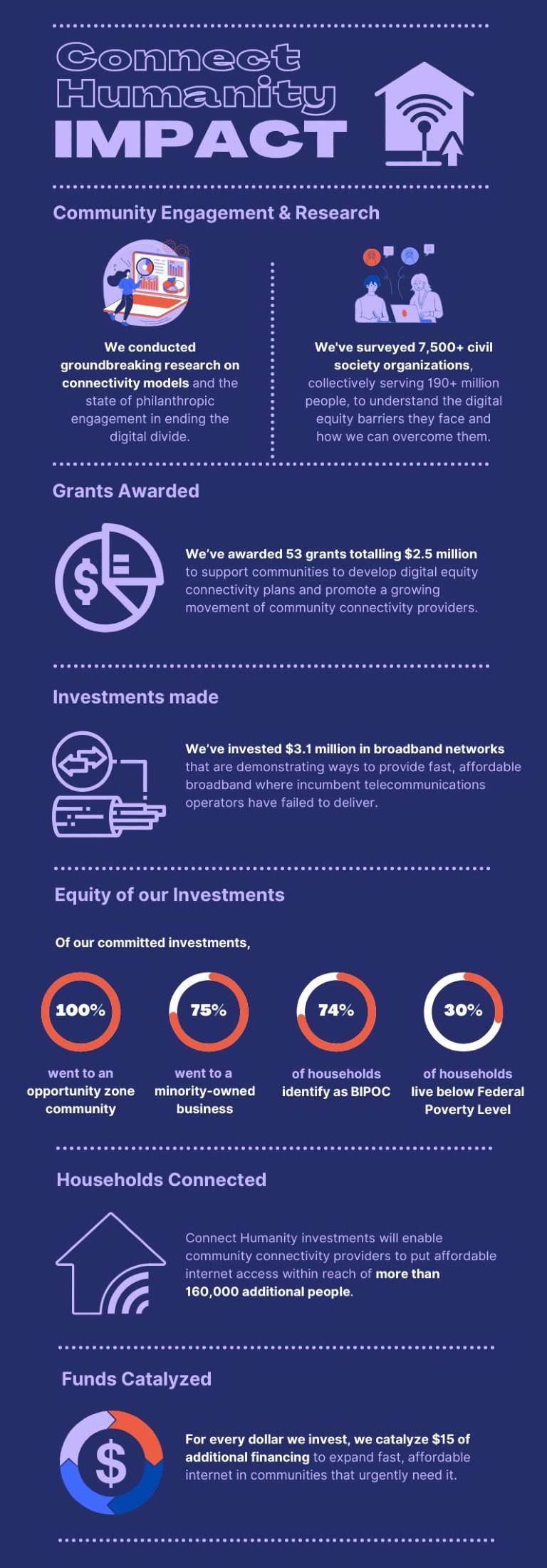
A deal in Macon County, Alabama demonstrated what blended capital can achieve. A $500k loan from Connect Humanity helped leverage a $250k grant from Rural LISC and $1.5M of public funding, alongside investment capital from the ISP. This partnership enabled a $3.1M fiber network build, extending fast, affordable internet to 1,500 homes, businesses, and community institutions across the county.


Makeup of blended capital stack financing the build
Makeup of blended capital stack financing the build
As a condition of our investment, we required a Community Benefit Agreement to ensure the ISP continues to deliver on the digital needs of residents over the long term. The project is already bearing fruit.
“From healthcare innovation at Tuskegee University to $140+ million in economic impact from the area’s newest jobs-engine — Tuskegee Commerce Park — this network is bringing opportunity to businesses and families across Macon County.”
A community network in Winnipeg’s North End goes live!
Most urban centers in North America have reliable high-speed Internet connectivity. However, there are often pockets of these same cities — typically in low-income communities — where broadband is not available or not affordable for many residents. The North End of Winnipeg is one such place.
As part of the Indigenous Connectivity Institute’s mission to support Indigenous-led broadband projects, it awarded its inaugural grant to North End Connect — a community-run project working to overcome digital barriers in Winnipeg’s North End neighborhood, home to Canada’s largest urban Indigenous population.
The first antennas went live this summer, beaming internet connectivity from the heart of downtown into the North End. This fixed-wireless community network will grow over time, providing fast, reliable internet to residents in low-income housing units at no- or low-cost, alongside skills training and other digital equity programs.
“This funding is critical for us to deliver programming in the neighbourhood and is already creating jobs and opportunities. From this foundation, we will build the network of people who will build a network of computers.”
Appalachia Digital Accelerator kicks-off
Appalachia has some of the biggest connectivity gaps in the nation, with many communities stuck on last-generation technology or no internet access at all. To change this, Connect Humanity and the Appalachian Regional Commission (ARC) launched a $7.9m partnership to support Appalachia’s least-connected communities to plan for next-generation broadband networks that serve families and businesses for generations to come.
We launched the Accelerator with over 50 communities that receive grant funding, technical assistance, and additional support to write their plans and secure public and private funding to build networks.
Meet the first Accelerator cohort
At the Accelerator kick-off workshop this fall, ARC Federal Co-Chair Gayle Manchin, showed her appreciation to the communities taking part:
"Thanks to the work you’re doing in your communities, Appalachians will have new opportunities for learning and job growth. They’re becoming connected to healthcare services in their own homes instead of having to drive hours to access health clinics. They are seeing a renewed sense of hope for the future.
We campaigned to change federal funding rules — and won!
Small and community-focused ISPs are best placed to close America’s digital divides. So when we saw that the US government’s $42B program to invest in broadband infrastructure included a Letter of Credit requirement that would lock out the vast majority of these businesses from participating, we had to act.
Seeing little traction with the agency administering the program, we helped build a coalition of allies and we got to work. Outlining the scale of the problem, galvanizing hundreds of business owners and community leaders to speak out, and mobilizing US Senators and House Reps, we successfully called for NTIA leadership to change the rules.
By ensuring all types of providers will be able to participate in this historic broadband investment, these changes will affect how billions of public dollars are spent, ensuring more of this critical funding gets to the communities that most need it.
Find out how the campaign started with a scribble and ended in victory.
The Indigenous Connectivity Institute is taking its next step
Connect Humanity helped form and incubate the Indigenous Connectivity Institute with the firm understanding that to properly work for the digital interests of Indigenous communities, it must grow to become a truly Indigenous-led, Indigenous-housed organization.
And so as the year closes, we're thrilled the ICI is preparing to transition to an indigenous-led host organization. Together with the ICI Advisory Committee and other partners, we're actively supporting the ICI in this next step in its journey. More to come soon!
This milestone is a testimony to the progress the ICI has made since launching in 2022 and we look forward to continued partnership to advance Indigenous digital equity and catalyze Indigenous-controlled broadband networks.


A snapshot of
Connect Humanity's 2023
January
We become an independent non-profit. Every dollar we raise now goes to close the digital divide.
January
Published the State of Digital Inequity Report
The largest-ever mapping of civil society's digital barriers
Representing the experiences of over 7,500 practitioners across 136 countries, the State of Digital Inequity report gives an unparalleled insight into the digital challenges facing civil society and the communities they serve.
While 95 percent of organizations said the internet is vital to their ability to do their work, three in four said that a lack of internet access, tools, or skills limits their ability to effectively serve their communities.
The message is clear: Not only is the internet today a basic right, it is critical to the success of all civil society organizations, whether they work on education or the environment, hunger or healthcare. That’s why we have consistently made the case that we can’t meet the SDGs without closing the digital divide.
February
Explored international work looking at how to best partner to advance digital equity beyond the US, beginning in Brazil.
March
Published our first impact scorecard. As we marked our first year of full operations, we shared our impact so far.
April
Building starts in East Carroll, Louisiana on a fiber network that will bring life-changing broadband to the community.
“Finally, we can see a brighter future ahead of us in East Carroll Parish”
We continue to support the work of church-based group Delta Interfaith in East Carroll, including by helping fund its digital navigator program and working on an investment deal that would bring the network into community ownership.
May
A deal in Alabama demonstrated the impact of blended capital
Connect Humanity was founded with the belief that blending different sources of capital — public, commercial, and philanthropic — will be essential to catalyzing viable broadband projects in some underserved communities.
A deal in Macon County, Alabama demonstrated what blended capital can achieve. A $500k loan from Connect Humanity helped leverage a $250k grant from Rural LISC and $1.5M of public funding, alongside investment capital from the ISP. This partnership enabled a $3.1M fiber network build, extending fast, affordable internet to 1,500 homes, businesses, and community institutions across the county.
Makeup of blended capital stack financing the build
Makeup of blended capital stack financing the build
As a condition of our investment, we required a Community Benefit Agreement to ensure the ISP continues to deliver on the digital needs of residents over the long term. The project is already bearing fruit.
“From healthcare innovation at Tuskegee University to $140+ million in economic impact from the area’s newest jobs-engine — Tuskegee Commerce Park — this network is bringing opportunity to businesses and families across Macon County.”
May
A partnership with Hawk Networks supported network builds in Dallas, TX & Atlanta, GA — and is helping reimagine the broadband sector.
June
We provided funding to support Peak to Peak Communications to boost broadband access in rural Plumas, Lassen, and Sierra counties.
July
We partnered with Appalachian Community Capital to raise IDEA Fund — Investing in Digital Equity in Appalachia — to invest in one of the least connected regions in the united states.
August
A community network in Winnipeg’s North End goes live!
Most urban centers in North America have reliable high-speed Internet connectivity. However, there are often pockets of these same cities — typically in low-income communities — where broadband is not available or not affordable for many residents. The North End of Winnipeg is one such place.
As part of the Indigenous Connectivity Institute’s mission to support Indigenous-led broadband projects, it awarded its inaugural grant to North End Connect — a community-run project working to overcome digital barriers in Winnipeg’s North End neighborhood, home to Canada’s largest urban Indigenous population.
The first antennas went live this summer, beaming internet connectivity from the heart of downtown into the North End. This fixed-wireless community network will grow over time, providing fast, reliable internet to residents in low-income housing units at no- or low-cost, alongside skills training and other digital equity programs.
“This funding is critical for us to deliver programming in the neighbourhood and is already creating jobs and opportunities. From this foundation, we will build the network of people who will build a network of computers.”
September
Appalachia Digital Accelerator kicks-off
Appalachia has some of the biggest connectivity gaps in the nation, with many communities stuck on last-generation technology or no internet access at all. To change this, Connect Humanity and the Appalachian Regional Commission (ARC) launched a $7.9m partnership to support Appalachia’s least-connected communities to plan for next-generation broadband networks that serve families and businesses for generations to come.
We launched the Accelerator with over 50 communities that receive grant funding, technical assistance, and additional support to write their plans and secure public and private funding to build networks.
Meet the first Accelerator cohort
At the Accelerator kick-off workshop this fall, ARC Federal Co-Chair Gayle Manchin, showed her appreciation to the communities taking part:
"Thanks to the work you’re doing in your communities, Appalachians will have new opportunities for learning and job growth. They’re becoming connected to healthcare services in their own homes instead of having to drive hours to access health clinics. They are seeing a renewed sense of hope for the future.
October
New Community Reinvestment Act (CRA) rules are published, encouraging funding for digital equity, in line with Connect Humanity recommendations.
November
We campaigned to change federal funding rules — and won!
Small and community-focused ISPs are best placed to close America’s digital divides. So when we saw that the US government’s $42B program to invest in broadband infrastructure included a Letter of Credit requirement that would lock out the vast majority of these businesses from participating, we had to act.
Seeing little traction with the agency administering the program, we helped build a coalition of allies and we got to work. Outlining the scale of the problem, galvanizing hundreds of business owners and community leaders to speak out, and mobilizing US Senators and House Reps, we successfully called for NTIA leadership to change the rules.
By ensuring all types of providers will be able to participate in this historic broadband investment, these changes will affect how billions of public dollars are spent, ensuring more of this critical funding gets to the communities that most need it.
Find out how the campaign started with a scribble and ended in victory.
December
The Indigenous Connectivity Institute is taking its next step
Connect Humanity helped form and incubate the Indigenous Connectivity Institute with the firm understanding that to properly work for the digital interests of Indigenous communities, it must grow to become a truly Indigenous-led, Indigenous-housed organization.
And so as the year closes, we're thrilled the ICI is preparing to transition to an indigenous-led host organization. Together with the ICI Advisory Committee and other partners, we're actively supporting the ICI in this next step in its journey. More to come soon!
This milestone is a testimony to the progress the ICI has made since launching in 2022 and we look forward to continued partnership to advance Indigenous digital equity and catalyze Indigenous-controlled broadband networks.
Looking forward


A new strategy for 2024 and beyond.
Since our founding two short years ago, Connect Humanity has put more than 160,000 people on the path to getting connected to high-speed, affordable internet access. As we’ve partnered with hundreds of communities, deployed millions in broadband-focused grants and investments, and catalyzed $47 million in capital for the community-focused ISPs we work with, we’ve learned a huge amount about financing sustainable broadband networks, driving impact for communities, and how our organization can best contribute to closing the digital divide.
All of these learnings have shaped an updated strategy that will guide our work over the next two years.
Over the next two years, we will increase our low-cost, flexible investments that enable community-focused ISPs to build in communities in need, while significantly growing efforts to mobilize other funders to do the same. In our first year, we catalyzed $15 for every $1 invested. By scaling this activity, we can direct hundreds of millions more dollars to advance digital equity. We will evolve the strategic advice we provide, helping unlock new partnerships and capital to support 100+ communities towards building and extending broadband networks. Finally, building on our advocacy successes, we’ll get more involved in calling for the policy changes required to level the playing field for community-focused ISPs and underserved communities.
This strategy defines four distinct but complementary roles for Connect Humanity:
We are matchmakers
We bring together underserved communities, ISPs who build and operate networks, and investors. These parties need each other but don’t always have relationships or speak the same language to collaborate effectively. Serving as a trusted advisor, we break down barriers and create strong partnerships that advance digital equity.
We are investors
We pioneer new models to sustainably and profitably finance community-focused ISPs on terms they and the communities they serve can afford. Capital is power and we use ours to structure deals that empower communities, including incentives and accountability mechanisms to ensure providers and investors deliver on commitments.
We catalyze more capital
Openly sharing our investment strategies, we are demonstrating that community broadband is a viable, profitable asset class. By forging partnerships and building capacity with other funders, we unlock more blended finance dollars to power the community-focused ISPs that can bridge the digital divide.
We advocate for community broadband
As a fund for digital equity we often hold unique insight into the policies and practices that can expand broadband in underserved communities. Working with partners, we share our learnings, shape policy, and build capacity for those who share our mission.




Join us.
Our strategic plan sets us up to transform community broadband finance and unlock hundreds of millions of dollars for community-focused ISPs that can meet the digital needs of communities everywhere.
Our work is only possible with your partnership.
Whether you’re a funder working to advance digital equity or an investor seeking an impactful home for your investment dollars, let’s start a conversation about how we can close the digital divide together.
Email us at info@connecthumanity.fund
Learn more at www.connecthumanity.fund
With thanks.
We are grateful for the generosity of the funders who supported our work in 2023, and the Truist Foundation in particular for being an integral partner and financial backer from the beginning.
- Appalachian Regional Commission
- The Aspen Institute
- C. S. Mott Foundation
- Duke Energy Foundation
- Empire State Development
- Endless Network
- Google Fiber
- Ford Foundation
- Mastercard Foundation
- Okta for Good
- Siegel Family Endowment
- Truist Foundation


 Built with Shorthand