
Black Bear Fiber secures $30 million to connect central Pennsylvania
Founder Dave Gibbons shares how the Appalachia Digital Accelerator helped deliver a major win for rural broadband
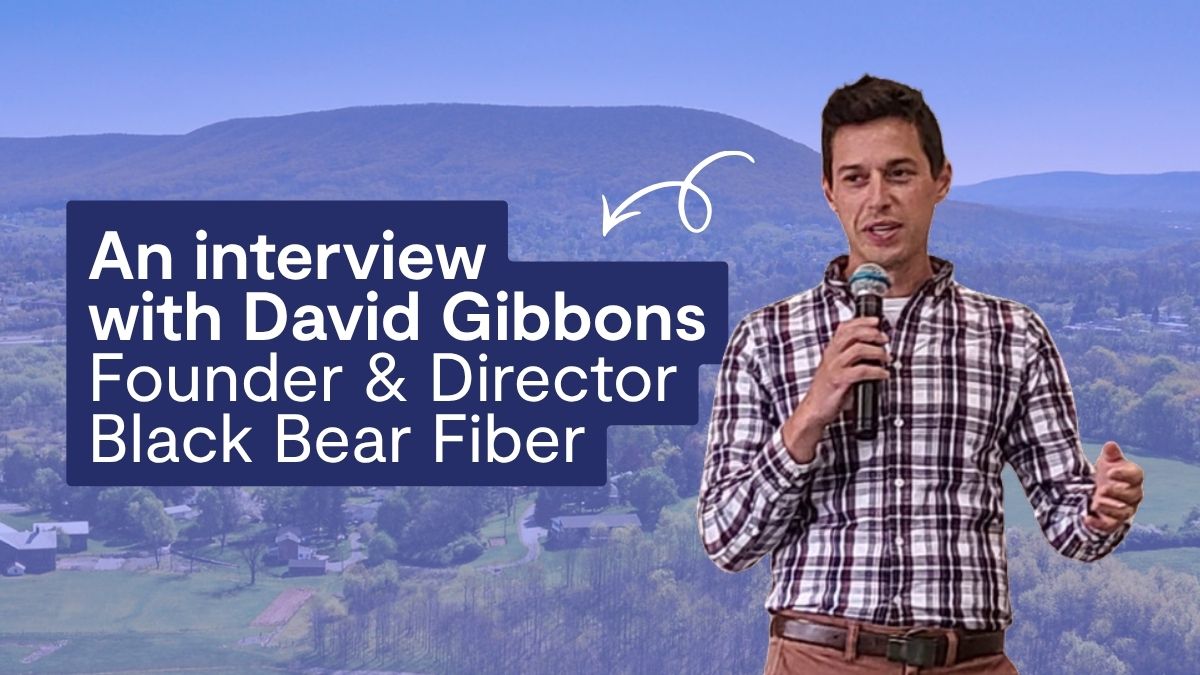
Long before he was building broadband across rural Pennsylvania, Dave Gibbons was disrupting monopolies in a college dorm room.
As a freshman at Gettysburg College in the early 2000s, he and a fellow student launched an online marketplace for students to sell their old textbooks directly, bypassing the campus bookstore, which bought low and sold high. When the store tried to block them from advertising, he pushed back and won.
“Sticking it to the man is definitely part of the ethos,” he laughs.
Two decades later, that same instinct to tackle practical problems and challenge incumbents has delivered a significant broadband win in rural central Pennsylvania.
Black Bear Fiber, the company Gibbons founded, has secured almost $30 million in combined federal grant and loan funding, with an $18.6 million USDA Rural Telecommunications Loan and a $10.8 million Broadband Equity Access and Deployment (BEAD) award, including match dollars from the county.
A few years ago, that outcome was far from certain. As the federal BEAD program began to take shape, Gibbons could see the scale of the opportunity. But given the program’s complexity and requirements, he also knew he would need additional capacity to seize it.
In 2023, he joined the Appalachia Digital Accelerator, a capacity-building initiative led by Connect Humanity in partnership with the Appalachian Regional Commission (ARC) created to strengthen the region’s ability to access historic broadband funding. The Accelerator supported participants to create 48 digital connectivity plans covering 71 communities across 11 Appalachian states.
With Accelerator support, Black Bear has raised a capital stack that will finance gigabit fiber to 8,000–10,000 unserved homes, with thousands more now within reach of its growing network.
A solvable problem
The areas Black Bear serves are rural, but not so rural to justify historical indifference from incumbent operators.
For years, many residents were left with aging copper delivering a few megabits per second on a good day. That’s barely enough for a video call, never mind remote work or telehealth.
“We’re not talking about five homes per mile,” Gibbons says. “We’re talking about 20, 30, 40 homes per mile. If you control your costs, you can make a reasonable business case.”
While there’s often a narrative suggesting rural broadband is too expensive or too hard, Gibbons sees it differently. Larger providers, he argues, simply prioritize denser markets with faster returns. But with the right financing partners, smaller ISPs can deliver where others chose not to.
Stepping up in Centre County
Black Bear’s origins trace back to 2015, when Gibbons, then running an IT services firm, helped Centre County’s YMCA building get online by constructing a relay network across mountains and farmland. That wireless solution evolved over time, and with support from Centre County, Juniata County, Mifflin County, and SEDA-COG, into Centre WISP, and later into the fiber-first Black Bear.
By the time Gibbons joined the Appalachia Digital Accelerator, he had already secured $12 million from the Rural Digital Opportunity Fund (RDOF), but still had a capital gap. Inflation had driven up costs on the RDOF build, and he needed additional financing to complete it. BEAD, meanwhile, offered an opportunity to bring fiber to entirely new areas.
“We really needed support to write funding applications,” Gibbons says.
Through the Accelerator, Black Bear had referrals to vetted grant-writers, financial support to engage them, and the opportunity to collaborate with counties and nonprofits tackling similar connectivity challenges. That capacity support — backed by Truist Foundation and Duke Energy Foundation alongside ARC — helped level the playing field for local providers competing for national-scale funding.
“We received significant help in applying for a low-interest USDA loan and for BEAD funding,” Gibbons says. “Both of those projects were made possible in large part by the Accelerator.”
Crucially, the USDA loan ensures Black Bear can complete its RDOF obligations without turning to extractive capital.
“For me, it was critical not to finance through private equity,” Gibbons says. “That kind of leverage removes your autonomy and your ability to serve communities the way you want.”
Local ownership, in other words, remains intact.
What fiber changes
When Black Bear lights up a new stretch of network, the response is immediate.
“We just finished a 30-mile rural build,” Gibbons says. “Within a month, we were nearing a 20% take rate. There is pent-up demand.”
Even customers coming from newer fixed wireless or satellite options see dramatic improvements, often a tenfold increase in speed, along with lower latency and greater reliability.
“I love connecting those customers,” Gibbons says. “Their jaws are usually on the floor.”
But for Gibbons, it’s about more than just increasing speeds.
He recalls one family who called to cancel service after the household’s primary earner was diagnosed with cancer. Rather than disconnect them, Black Bear waived the monthly cost while the family navigated treatment. In other communities, the company has provided discounted or free service to local fire departments and community centers, ensuring residents have reliable public Wi-Fi when they need it.
“If you want to be a citizen in modern society, you need broadband,” he says. “If you want to be a student, an employee, connect with family, you need broadband. That’s what we do.”
Why enabling work matters
Small, locally rooted ISPs often operate with lean teams, balancing engineering, customer service, and construction, while navigating complex federal funding programs. Those programs are designed to move billions of dollars, but they are not always designed for small operators.
That is the gap the Appalachia Digital Accelerator was built to address. With ARC’s support, it strengthens the region’s ability to access historic broadband funding by ensuring communities and providers have the expertise to compete on equal footing.
In Black Bear’s case, that early investment in capacity translated into almost $30 million in secured capital — and thousands of homes on track for fiber.
While the success of companies like Black Bear offers reason for optimism, the broader environment for community-centric ISPs remains challenging.
Gibbons worries about consolidation in an already concentrated market, where private equity-backed networks are being rolled into large incumbents. In competitive areas, those incumbents frequently undercut smaller providers only to raise prices once competition exits.
“The negative outcomes of consolidation take a few years to show up,” he says. “And when they do, it’s the consumer who will lose out.”
Supporting local providers now, he argues, is one way to preserve competition, accountability, and long-term affordability in rural markets.
His closing advice is straightforward:
“Support your local broadband providers. They’re going out on a limb with investment and effort to build competitive networks in places that have been ignored for a long time. With access to the right kind of capital partners, they can do a lot more.”
If we want a more connected future for rural communities, we need to create an environment that powers the success of providers like Black Bear Fiber — because they are the ones doing the hard work of building it.
—–
The Appalachia Digital Accelerator is a capacity-building program that supported 24 grantees to create 48 digital connectivity plans covering 71 communities across 11 Appalachian states. The project was created in partnership with the Appalachian Regional Commission (ARC), which contributed $6.3 million (80% of the total project cost), with match funding contributed by Truist Foundation and Duke Energy Foundation.
Keep in touch
To learn more about our work follow us on social media, subscribe to our newsletter, and write to us anytime at info@connecthumanity.fund.