
Broadband is back in Fleming-Neon: How community perseverance paid off
A rural Kentucky community's fight to better broadband is creating a movement for renewal
This article is based on an interview with Cheryl Hawkins that took place in September, 2025
In the summer of 2022, floodwaters tore through Fleming-Neon, Kentucky, rising twelve feet high on Main Street. Homes were swept away, City Hall was submerged, and basic services — power, water, internet — were cut off. In the aftermath, residents came together to recover and reimagine their town.
Cheryl Hawkins remembers how quickly people shifted from crisis to action: “People came to meetings not to talk about replacing what was lost, but with ideas on how to rebuild something better,” she explains. “So we formed the group ‘Neon Rising’ — rising from the floodwater.”
That spirit has defined Fleming-Neon’s recovery. And nowhere is it clearer than in the fight for reliable internet.
A community determined to connect
Fleming-Neon had struggled with unreliable internet for years. The flood made things worse, damaging broadband infrastructure that went unrepaired. While people continued to pay their bills, they couldn’t get stable service. Families often had to rely on cell phones for everything. Many gave up trying.
“I knew something was wrong from the top to bottom with our internet,” Cheryl says. “We’d call, file tickets, stop trucks in the street — and nothing changed.”
That’s when Fleming-Neon joined the Appalachia Digital Accelerator, a Connect Humanity program helping communities plan for broadband, backed by the Appalachian Regional Commission (ARC) with additional support from Truist Foundation and Ford Foundation. Through the Accelerator, residents learned how broadband systems work, why gaps persist, and what tools communities can use to hold providers accountable.
Across the board, residents weren’t getting the service claimed by the incumbent cable company.
They ran a broadband “challenge process,” rallying neighbors to take speed tests that documented the service they actually received. Across the board, residents weren’t getting the service claimed by the incumbent cable company.
Organizing gets results
At first, the provider refused to acknowledge there was a problem — even after Connect Humanity brokered a meeting between the ISP and community members along with broadband experts, offering to help identify the problems and resources to fix it. Still, company representatives told residents to just keep submitting service tickets.
But Cheryl wouldn’t let it go. She drove an hour to the company’s office, demanded to speak with someone until she eventually reached a manager willing to listen.
“She pulled up the records and said, ‘Oh my gosh — look at all these tickets that were never addressed,’” Cheryl recalls. Within days, technicians were in town. Within weeks, lines were repaired or replaced. Today, many homes have jumped from barely able to connect to near-gigabit speeds.
The turnaround was dramatic. By organizing residents, documenting problems, and showing they were serious about alternatives, Fleming-Neon forced a response that had seemed impossible months earlier.
Within weeks, lines were repaired or replaced. Today, many homes have jumped from barely able to connect to near-gigabit speeds.
From connectivity to community impact
Improved broadband is already transforming daily life. Residents can finally manage routine online tasks, children are able to keep up with schoolwork, and people are exploring new opportunities without leaving town.
For Cheryl and Jeff Hawkins, this is only the beginning. They see connectivity as the bridge to Fleming-Neon’s future — linking the community to new businesses, enabling remote work, and creating opportunities in a town once dominated by coal.
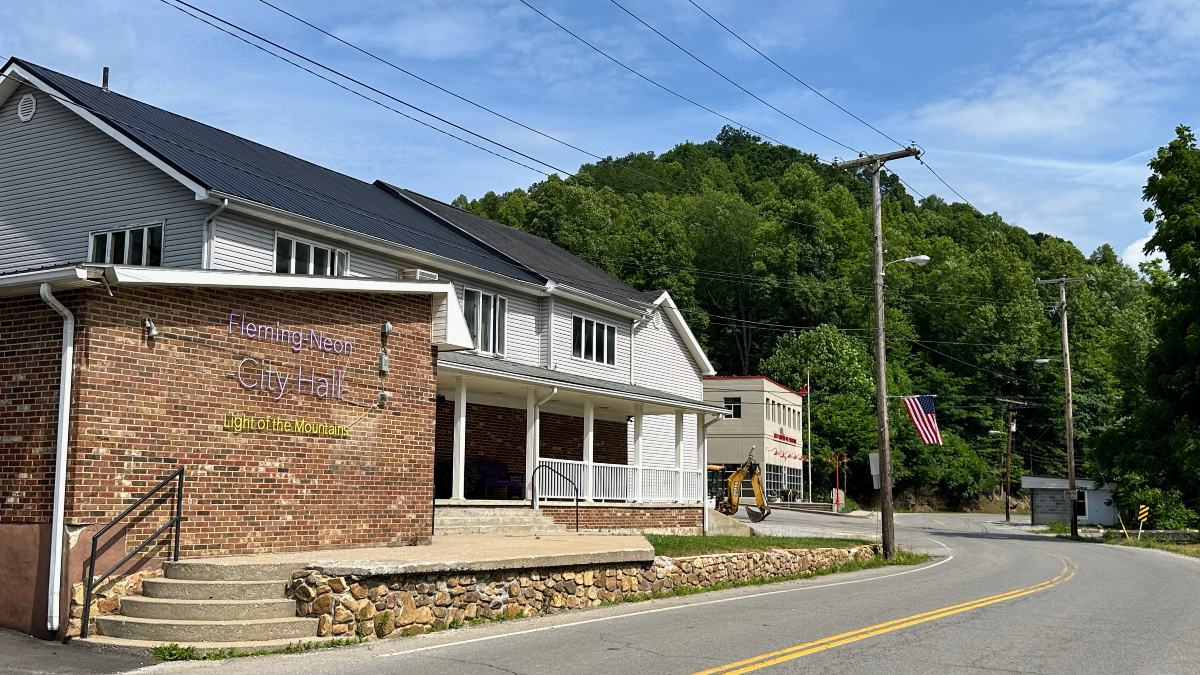
Through the Neon Rising nonprofit organization, they’ve been creating a Digital Hub and workforce center in the old City Hall. Further renovations are underway, starting with new sidewalks, street lighting, and essential repairs to the building, funded by a USDA grant.
The hub is already open to community members who are coming in to connect and get technology help where they need it. Cheryl and Jeff are working to be able to meet the demand for a broader set of services, with a plan for the hub to deliver:
- Public computers, wifi access, and printing facilities.
- A digital navigator to help residents with online tasks.
- Training in digital skills and remote work.
- A space for telehealth services, addressing the loss of a local medical center.
- Support for entrepreneurs and small businesses.
The to-do list remains long. Neon Rising is seeking support for programming, staffing (particularly digital navigators), and interior buildout of the hub.
Beyond the hub, fiber-to-the-home remains a priority, with Accelerator work sparking discussions between the city government, county officials, and utility leaders about laying fiber alongside sewer reconstruction. And with digital monitoring planned for the town’s water system, fiber is quickly becoming a must-have to support “smart” infrastructure in Fleming-Neon.
Cheryl’s advice for other communities
When asked what advice she has for community leaders facing similar uphill battles, Cheryl doesn’t hesitate: perseverance.
- Organize residents and local leaders to move forward together.
- Partner with allies who bring knowledge and credibility.
- Document everything and make the problem visible.
- Don’t give up — even when providers dismiss you.
“There are a billion ways to solve a problem,” she says. “If one doesn’t work, another will. Don’t give up.”
Fleming Neon shows it can be done
Fleming-Neon is proving what’s possible when communities refuse to be ignored. Just three years ago the town faced disaster. Today, residents are busy revitalizing downtown, securing infrastructure investments, holding providers accountable, and laying the foundation for a digitally connected future.
There are a billion ways to solve a problem. If one doesn’t work, another will. Don’t give up.
No one can do this alone — local and national partners can provide vital support for communities working to bridge digital divides. Connect Humanity is always open to talk about what you need. Other organizations to explore include:
- The National Digital Inclusion Alliance (NDIA)
- Appalachia Regional Commission (ARC)
- American Association for Public Broadband (AAPB)
- Community Broadband Networks (ILSR)
- The Benton Institute for Broadband and Society
Can you support Fleming-Neon’s future?
Neon Rising is seeking partners to fund digital navigator roles, support programming at the new hub, and help bring fiber the last mile. To learn more, get in touch.
Keep in touch
To learn more about our work follow us on social media, subscribe to our newsletter, and write to us anytime at info@connecthumanity.fund.