
South Texas colonia students step up as tech connectors
A showcase of the Rio Grande Valley Digital Ambassadors Program


Las Milpas, near the US-Mexico border, stands as a Texas success story. Thanks to decades of dedicated local leadership, the colonia has transformed from a neighborhood lacking safe housing and infrastructure for electricity, plumbing, and potable water, into a thriving community with schools, a community center, small businesses and over 25,000+ residents. In 1987, it was incorporated into the City of Pharr as South Pharr.
Despite strides in development, critical infrastructure gaps persisted, including a lack of reliable, affordable broadband. But the 2023 launch of TeamPharr.Net, a municipal fiber-to-the-home network, was a turning point, bringing high-speed internet into South Pharr.
While the expansion of internet access holds tremendous community benefits, it comes with a real need for digital literacy training to help more people get online and use technology to access public services, telehealth, and more.
In response to this need, the Intercultural Development Research Association (IDRA) and ARISE Adelante, two prominent South Texas organizations, joined forces to launch the Digital Ambassadors Program, to train high-school students in four colonias as guides to help residents in Las Milpas, South Tower, Muñiz, and Hargill with essential digital skills.
Connect Humanity provided ARISE Adelante with a grant to support the project as part of our broader efforts to advance digital equity in South Texas through the Rio Grande Valley Broadband Coalition, a coalition initiated by Connect Humanity in collaboration with Rural LISC.
South Texas Colonias
Las Milpas (South Pharr), South Tower, Muñiz, and Hargill where ARISE centers are located are among almost 2,300 colonias (translated as ‘neighborhoods’) along the Texas-Mexico border. Colonias typically have substandard self-built housing and lack basic infrastructure including clean water, sewage systems, paved roads, drainage, and broadband. Colonias lie in the persistent poverty region of the border and tend to have even higher poverty rates than the counties they inhabit.
ARISE president Lourdes Flores emphasizes the strength of community spirit:
“A colonia is a community, a neighborhood, a group of people that are helping one another. There's a sense of what we call ‘juntos’.”
Colonias are generally unincorporated rural communities which started as housing settlements for farmworkers, but they can also be peri urban neighborhoods or small towns. Since many are in Metropolitan Statistical Areas of cities, they often don’t qualify as ‘rural’ for federal grant programs.
In 2023, the Federal Housing Finance Agency, recognized that colonias are ‘rural in nature’, making more financing available for community development. Others, such as the USDA are narrower in their rural definition which means many colonias are excluded from grant programs they desperately need. Funding, including for broadband infrastructure and digital equity programs, is extremely short.
The Digital Ambassadors pilot program
Like others working in community development, Michelle Vega, Chief Technology Strategist at IDRA, knows that broadband is not a case of ‘build it and they will come’:
“Digital skills are as important as broadband access. Once someone has internet service, they then need the device to use it, and the skills to to use that device.”
For ARISE President Lourdes Flores, the only way to do this right is to start by meeting colonia residents where they are:
“When we talked with people, they would give us a long list of things they wanted help with [to use digital devices]. People are paying attention and they’re ready. They know what they need.”
When Lourdes and Michelle discussed how to meet this need for digital skills training, they saw a perfect opportunity to equip young people with the tools to deliver this training in their own communities.
“Students already have a wealth of experience and they speak the language that their parents speak,” Michelle said.
“This made them a natural bridge between the technology and being able to communicate with others that need help using it.”
This insight was the spark that led to a Digital Ambassadors Pilot that aimed to bridge the digital skills gap by transforming students into technology trainers.
25 students aged 12-18 living across the four colonias signed up to be Digital Ambassadors. They worked in three phases:
Research
To ensure the program delivers the skills residents most want help with, digital ambassadors started out by designing and deploying a survey to uncover the technology struggles that colonia residents experience most acutely. 110 community members were surveyed, revealing needs for training in areas such as using the keyboard and mouse, learning basic device functionality, internet safety, setting up email accounts, using online bank banking, and applying for jobs.
Mastery
Next ambassadors were trained in the specific skills identified by the survey as most in demand. The students were also given coaching on how to be effective trainers, helping build their confidence for the third phase where they would work directly with residents.
Dissemination
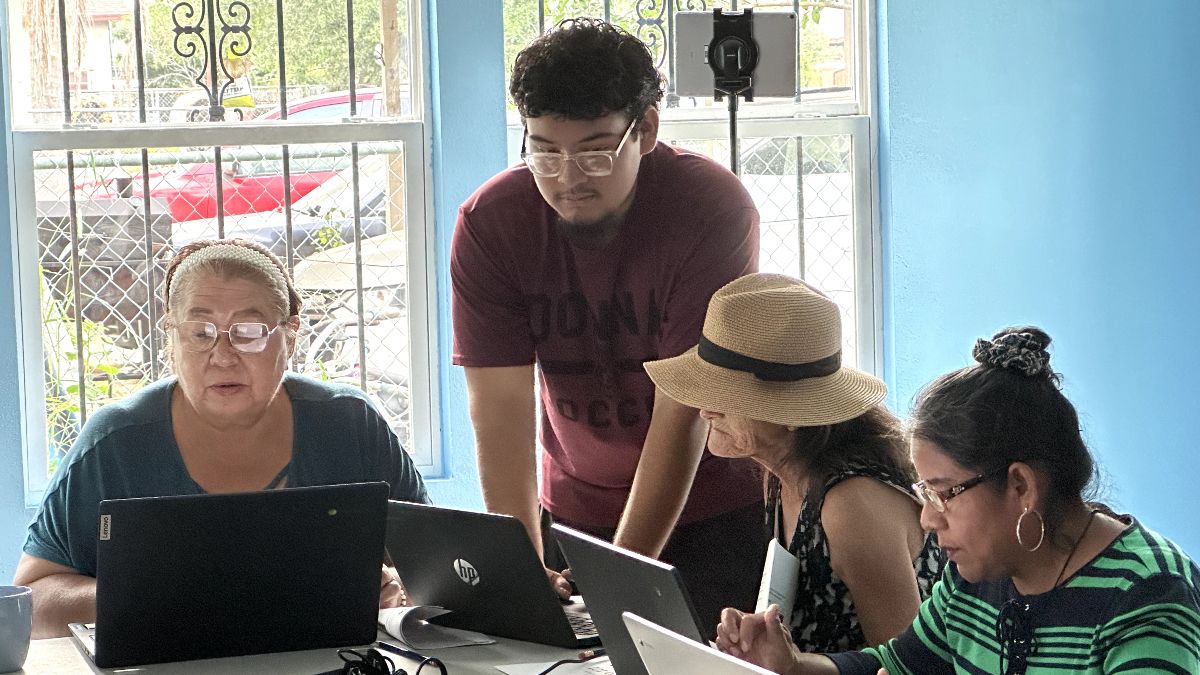
Finally, students provided training, helping local residents navigate devices and take advantage of online services. 62 residents participated, receiving training across ARISE’s four locations and in local health centers. Prior to this, many people had only experienced the internet via a cell phone, so having hands-on instruction on laptop computers with their student-teachers was profound.

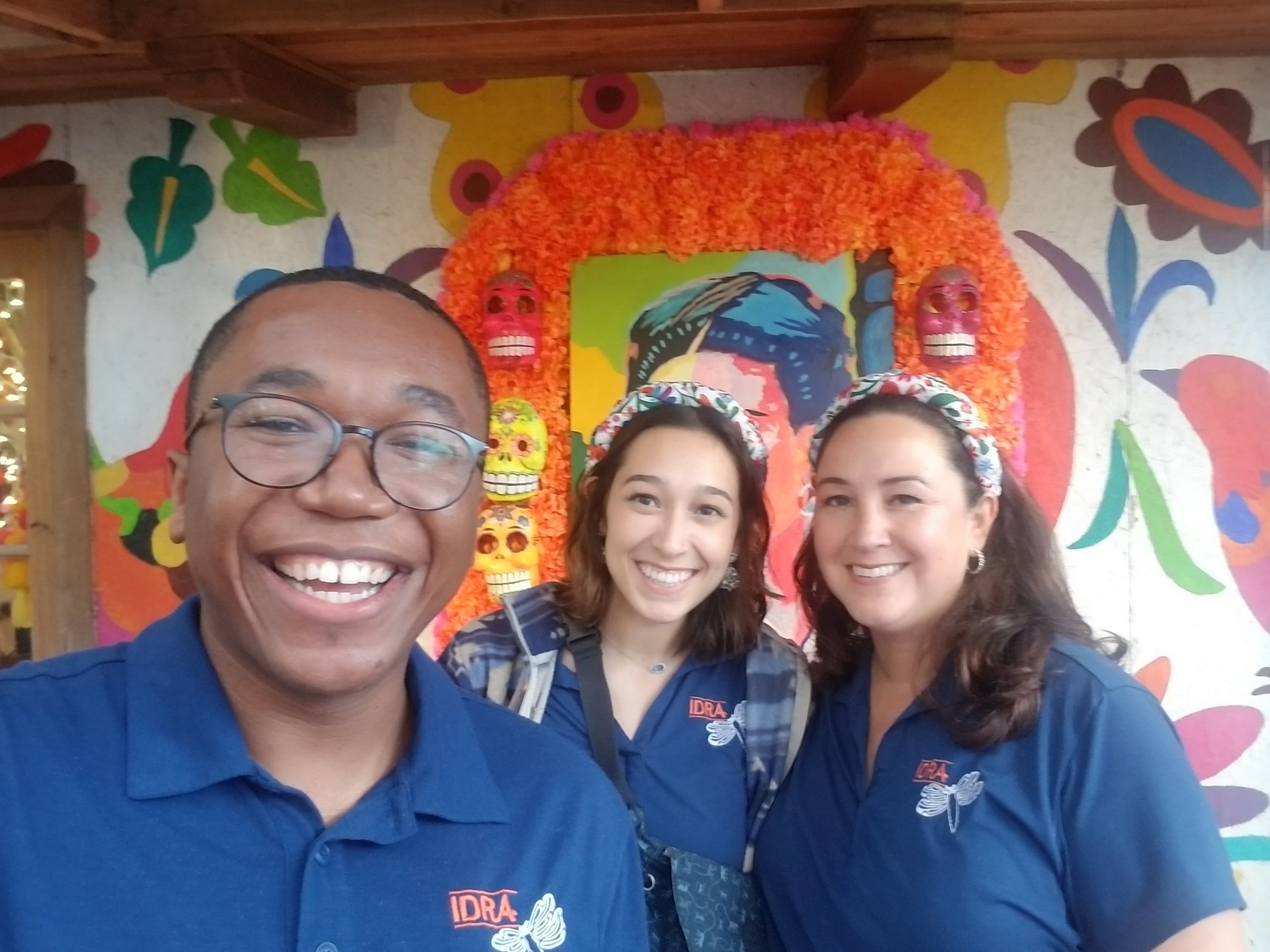


“It was amazing watching the participants put their hands on the keyboard. For some of them, it almost seemed like the first time that they did that. And the students did all of the training in Spanish and were able to really connect with people and provide them with the resources they needed.”
Michelle Vega, IDRA
The next generation of leaders
While the program provides a valuable service to local residents, its real magic comes from the trust and opportunity students experience as they step up as community leaders.
Students were empowered with designing and delivering the program soup-to-nuts. They took the major program decisions, designed interview questions, and overcame challenges as they arose. And there were challenges — especially because many of the ambassadors were balancing their participation with their school, extracurricular activities, and work commitments.
Aurelio Montemayor, Family Engagement Coordinator at IDRA, is a long time educator having started out teaching English in the 1960s. He saw how much the students were capable of when empowered to drive the program:
“When I saw these students discussing the meaning of questions and the semantic issues in developing a survey, I thought I died and went to heaven."
"Because to get students in a regular classroom doing that level of analysis of language is really hard. Yet, we had these kids saying, you know what, we have to redo these questions, this isn’t quite right.”
The students were designing a survey for an audience and purpose that was real to them, not a classroom exercise.


Presenting at the 'Mesa Comunitaria'
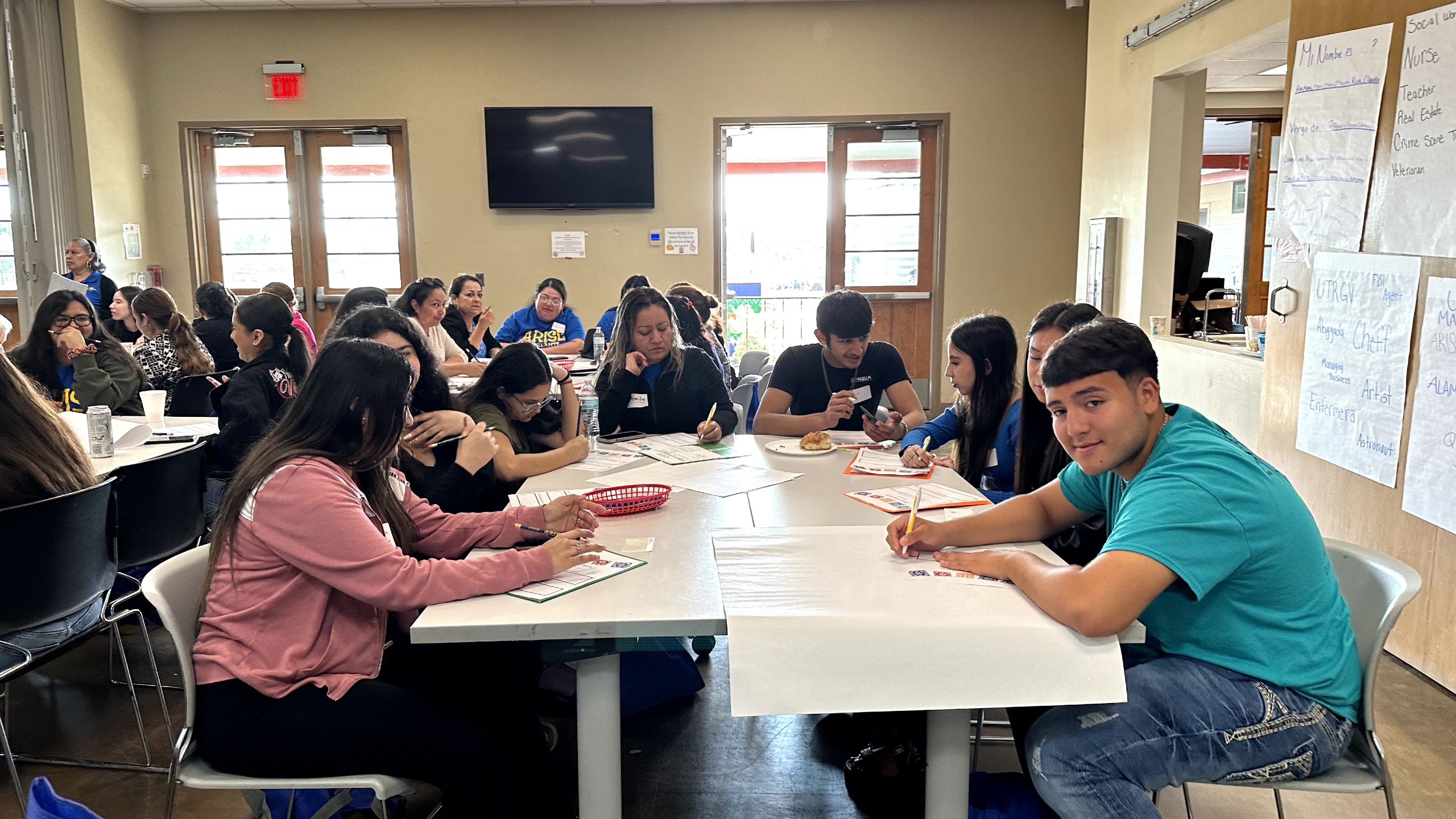
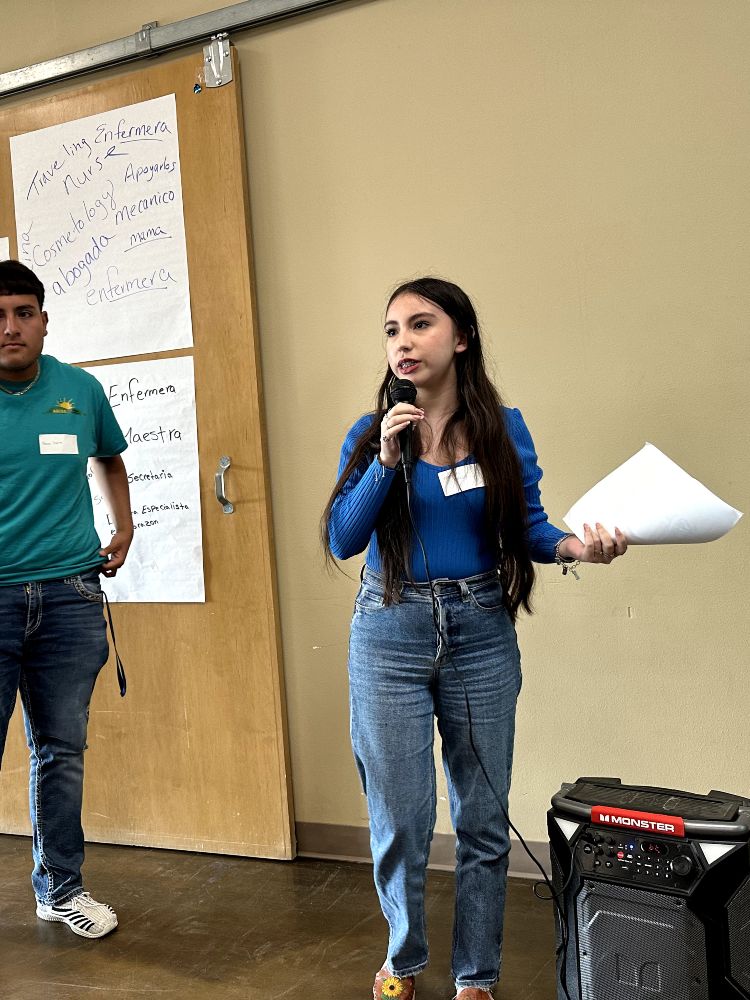
As part of the research phase, ambassadors joined an annual community roundtable to discuss the region’s learning agenda for the year ahead. At the 'Mesa Comunitaria' they presented their survey findings and invited feedback to strengthen their approach.
Speaking to large crowds can be intimidating and, for many of the ambassadors, presenting to the almost 100 participants was one of the biggest challenges they faced in the program. But with support from their peers, they flourished. Lourdes Flores, ARISE President, saw them rise to the occasion:
“One or two were very shy, but the kids stood next to them to give them that moral support of saying you can do it. And they did it. They did an amazing job.”
“I was nervous at the beginning of the presentation, but then I got confident because I felt proud of myself for helping the community with the things that I learned with the Digital Ambassadors Program.”
“The Digital Ambassadors Program helped me with getting out of my comfort zone, and I just like speaking about the topic."
Putting trust in young people and cultivating their talents is in IDRA’s DNA. 35 years ago IDRA started the Valued Youth Partnership supporting students at-risk of dropping out of the school system to become mentors for younger students. It’s about seeing the potential of youth in the colonias and giving them the tools to succeed.

Mariela Cavazos, Digital Ambassador
Mariela Cavazos, Digital Ambassador

Carlos Alvarez, Digital Ambassador
Carlos Alvarez, Digital Ambassador

Ivana Salazar, Digital Ambassador
Ivana Salazar, Digital Ambassador
“We know that any child, any teenager, if you connect them in the right way, their talents come out, their gifts come out. No matter how poor, how limited their education, if you give the right support and connect to their desire to achieve, their brilliance comes up every time.”
Aurelio Montemayor, IDRA
Preparing for technical careers
For internet service providers building a customer base in previously unserved colonias, gaining trust is essential. One of the best marketing tools is to engage with and employ people from these communities.
The program creates a win-win-win. Residents get bilingual technical support and are more likely to subscribe for service. Students build skills that put them on the path to a tech career or other good jobs that require digital skills. And local Internet Service Providers — such as TeamPharr.Net — have a means to connect with residents and sign them up for low-cost service. ISPs also gain access to a pipeline of talent to staff their bilingual help desks and, with the right training, build and manage broadband networks.
TeamPharr.Net's marketing team hired three student Digital Ambassadors and five parents to conduct outreach to sign South Pharr residents up for service. They contributed to remarkable growth of the network. In the first 15 months of operation, TeamPharr.Net achieved the following within South Pharr:
- 7,292 homes passed
- 3,039 Active Household Subscriptions
- 42% take rate
“When young people build this very practical set of skills they start to see the opening of a career. So rather than think in abstract terms 'I want to go for this or that,' they instead think 'I could become a programmer or a network engineer.' That has a great future.”
In the next iteration of the Digital Ambassadors Program, IDRA and ARISE hope to raise funds to create paid positions for students to do this work.
And, the Digital Ambassadors Pilot is just the first step. IDRA is now seeking funding to build a ‘TechXperts’ program that would also employ students to run a tech helpdesk on campus in which they would gain ComptTIA ITF+ certification qualifying them for a job straight out of school. For some, this will directly lead to a successful career. For others, this income will help pay the costs of college so they can expand their knowledge and credentials to advance their career in tech and other fields.
“We don't know where they're going to want to take the skills that they learn. But if we train them on transferable skills, and if we expose them to what's out there, then they can decide for themselves what they want to pursue.”



What’s next
IDRA and ARISE are looking to scale this work to train the next cohort of ambassadors and make digital literacy training available in more locations and for more residents.
“Now that the community knows it can be done, and they love these workshops, they're going to hope that the centers are available to them, but resources are a huge challenge.”
The organizations also have a vision to build a computer lab so residents that lack home broadband have a safe place to come to access high-speed internet and the support they need to navigate and use digital technology.
More digital skills training in colonias is vital. As a train-the-trainer model, the economic and social impact of the Digital Ambassador Program and the TechXperts initiatives will be profound, building skills while training future leaders in the colonias.
To learn more about these programs and how you can help sustain them, visit www.idra.org
Or contact:
Michelle Vega, IDRA Chief Technology Strategist, michelle.vega@idra.org
Lourdes Flores, ARISE President, lflores@ariseadelante.org
To learn more about the Rio Grande Valley Broadband Coalition, contact Jordana Barton-Garcia, jordana@connecthumanity.fund
This story was created as a collaboration between ARISE Adelante, IDRA, and Connect Humanity. It was written by Calum Cameron and Jordana Barton-Garcia based on an interview with Lourdes Flores, Michelle Vega, and Aurelio Montemayor. Photographs were provided by Michelle Vega, Aurelio Montemayor, and Christina Munoz. It was designed and published by Calum Cameron.





 Built with Shorthand